.

Sunday, May 11, 2014

New Zealand Dollar Rise Threatens Economic Recovery

New Zealand Dollar Rise Threatens Economic Recovery
Having risen nearly 30% against the US Dollar since March, the New Zealand Dollar (NZD or Kiwi) is now close to a 9 1/2 month high. While still far from the record highs of 2008, the currency is already erased a large portion of the losses it racked up since the credit crisis gave way to economic recession.

As part of last Friday’s coverage of the Japanese Yen, we included a chart which compared the performance of the AUD/JPY cross to the S&P 500. Even without calculating the correlation coefficient, a cursory review of the chart revealed an uncanny relationship! Unsurprisingly, it turns out the same relationship also applies to the New Zealand Dollar, whose recent performance closely mirrors US equities.
nzd
In other words, the interplay between risk appetite and risk aversion continues to dominate the forex markets, as traders move to calibrate the split of funds between so-called safe haven currencies and the riskier alternatives, among which the New Zealand Dollar is certainly counted. Much of the rally in the Kiwi, then, represents a correction, as investors acknowledge that the near 50% slide from-peak-to-trough was an overreaction.
Going forward, however, the Kiwi will have to rest on its own feet, as new themes move to the fore of investors’ minds. Specifically, they will begin to look more closely at the New Zealand economy, and demand evidence of a recovery. “Reserve Bank of New Zealand Governor Alan Bollard told a business audience the world has ‘avoided a repeat of the Great Depression. Now, we and the world, appear to be on our way to recovery. New Zealand looks likely to start recovering ahead of the pack.’ ”
At the same time, the most recent economic data showed an economy in freefall, as “New Zealand’s economy shrank for a fifth straight quarter…The economy contracted 2.7 per cent in the January-March quarter.” While forecasts vary, GDP is expected to fall by at least 2.1% in 2009, with a modest pickup expected in 2010. Investors are betting that the recovery will be driven by rising demand for commodities, which will help to buoy New Zealand exports. Once again, this conflicts with the data, which shows an annualized trade deficit of $3 Billion. Despite a fall in imports, the country is still importing more than its exporting. This could be a product of the stronger currency, which all stakeholders agree is not conducive to economic growth. In the end, the economy’s best chance for recovery lies in a resumption of debt-induced consumption and residential construction, the very forces which caused the current downturn. Says Mr. Bollard, “Reliance on past experience of strong house price inflation and easy credit will be untenable.”
Given the uncertain prospects for growth, combined with moderating price inflation, the RBNZ can be expected to hold interest rates at current levels for the near-term. “Bollard will leave the benchmark interest rate unchanged at a record low 2.5 percent on July 30, according to all 10 economists surveyed by Bloomberg.” Based on swap rates, the markets feel similarly, and are pricing a mere 25 basis point hike over the next twelve months. With such a dubious prognosis, one has to wonder whether the Kiwi’s rally is really sustainable.
new-zealand-cpi-inflation2

Canadian Dollar Slated to Outperform Other Commodity Currencies

Canadian Dollar Slated to Outperform Other Commodity Currencies
In the same vein as Monday’s and Tuesday’s posts (covering the New Zealand Dollar and Australian Dollar, respectively), I’d like to use today’s post to look at another commodity currency – the Canadian Dollar. The Loonie, it turns out, has also benefited from the a recovery in risk appetite and concomitant boom in commodity prices; it has appreciated by 7% against the USD in the last month alone, en route to a ten-month high. “All in all, with almost everything going its way these days (besides the crummy weather and the impact on tourism), a return trip to parity – last visited nearly one year ago – doesn’t seem far fetched,” chimes one optimistic analyst.

cad-usd
Like Australia and New Zealand, Canada’s economic fate is tied closely to commodity prices. Simply, as oil and other natural resources have inched closer to last year’s record highs, the Loonie has rebounded proportionately. “Raw materials account for more than 50 percent of Canada’s export revenue. Crude is the nation’s largest export.” Of course, this relationship works both ways. Any indication that the global economic recovery is stalling, and commodities prices would likely tumble, bringing commodity currencies down likewise.
Unlike the Australian Dollar and New Zealand Dollar, the Loonie has never really held much appeal as a carry trade currency. Even at their peak, Canadian interest rates were mediocre, from the standpoint of yield. The current rate is a measly .25%, compared to 2.5% in New Zealand and 3% in Australia. Moreover, while Australia may begin tightening as soon as the fall, “The Bank of Canada committed to keep its key policy rate at the lowest possible level until the spring of 2010,” after voting to hold rates at yesterday’s rate setting meeting. This interest differential could explain why the Aussie has outpaced the Loonie of late.
cad-aud
Another key difference – and potential explanation for the currencies’ recent divergence – is that Australia is considered part of the Asian economic zone, while Canada’s economic fortunes are closely aligned with those of its main trading partner, the US. China, alone, is helping to lift Australia out of recession. The US, meanwhile, is still struggling to find its feet. Hence, it is projected that Canadian GDP will contract by 2.3% in 2009, while Australian GDP may fall by a modest .5%. “When things look bad, you are more likely to sell Canada than the Australian dollar because its economy is moderated by Asian growth,” explains one analyst.
Going forward, this regional differentiation could actually work to the advantage of Canada, which is forecast to grow by an impressive 3% in 2010, compared to 1% growth in Australia. Accordingly, one analyst advises that “Investors should sell Australia’s dollar against Canada’s as a ‘relative commodity play’ because an attempt by China to reign in bank lending on concern it may be creating asset-price bubbles could slow Asian growth…’The Canadian dollar should outperform because it is much more closely linked to a recovery in the U.S.’ “

Risk Aversion Hits Australian Dollar

Risk Aversion Hits Australian Dollar
These days, I feel like you could take that title and substitute pretty much any currency for the Australian Dollar. Let’s face it- the EU sovereign debt crisis has hit a number of currencies extremely hard, as investors have fled anything and everything risky, in favor of the US Dollar, Swiss Franc, Japanese Yen, and Gold.
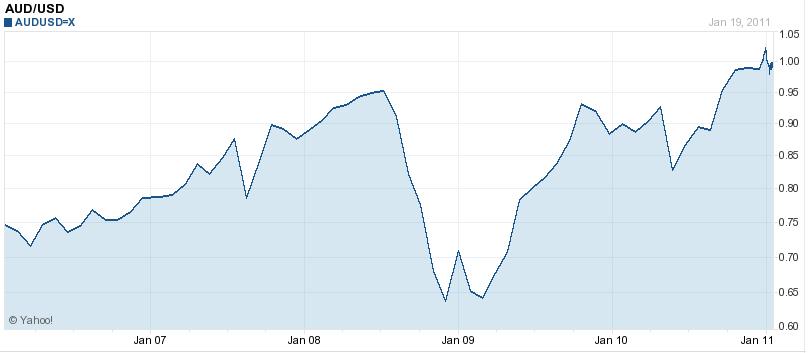
 Still, the Australian Dollar merits special attention, because in the forex markets, it has come to be a symbol of risk-taking. For veritable years, every credit expansion and economic boom has been accompanied by a surge in the value of the Aussie, and 2009 was no exception. As the global economy recovered and risk aversion ebbed, the Australian Dollar rose by more than 40% against the USD. It has been helped in its upward course by Chinese demand for its natural resources and strong interest rates, especially compared to the rest of the industrialized world.
AUD USD 2 Year Chart
 
That the Australian Dollar has already fallen 14% (from peak to trough) against the US Dollar over the last month is less due to economic and monetary factors, however, and more the result of an ebb in risk-taking. “The Australian dollar is considered a barometer of global risk appetite. Its fall reflects the quick change in mood, as Europe’s debt problems and China’s monetary tightening plans cloud expectations for the global economic growth,” summarized one analyst.
 
Specifically, investors are growing increasingly nervous about the viability of the carry trade, of which the Australian Dollar has been one of the primary beneficiaries. Uncertainty surrounding the fiscal problems of the Eurozone has catalyzed a spike in volatility, and investors have responded by rapidly unwinding their carry trade positions. Ironically, this caused a temporary upswing in the Euro, at the expense of the Aussie: ” ‘The euro rally isn’t that people like the euro. Investors have decided they want out of risk.’ The way to remove that risk from portfolios is to pay back the euro loans by selling the Australian dollar.”
 
From another standpoint, the yield advantage associated with holding Australian Dollars is no longer enough to compensate investors for the added risk. After adjusting for inflation, real interest rates in Australia are only about 2.5% (the nominal benchmark rate is 4.5%). This is still 2.5% higher than the benchmark US Federal Funds Rate, but not very attractive if you consider that the Australian Dollar has fallen by more than 2.5% against the US Dollar in several individual trading sessions in May. Moreover, the Reserve Bank of Australia (RBA) is signalling a pause in its rate hikes. If futures contracts are any indication, the Fed and the ECB will raise their respective interest rates before the RBA moves again.
 
Going forward, the consensus is that a sustainable level for the Australian Dollar based on current fundamentals is probably around .75 AUD/USD. However, the Aussie rallied 5% against the US Dollar last week, which suggests that investors still aren’t ready to give up completely: ” ‘The environment is not yet ripe to get truly bearish on the Australian dollar,’ said Commonwealth Bank Strategist Richard Grace. There are positives on the horizon, namely a better outlook for the U.S. and a calming of the Greek crisis, he said. He’s forecasting a return to $0.87.” Personally, I could see the Aussie going either way. Parity probably isn’t on the table anymore, but virtually everything else still is.

New Zealand Dollar Thriving in Obscurity

New Zealand Dollar Thriving in Obscurity
It’s understandable that forex investors basically ignore New Zealand. Its economy is around 10% the size of its neighbor Australia, its currency is less liquid, and spreads are higher. Given that its performance closely tracks the Australian Dollar, meanwhile, why pay it any attention?

NZD AUD 1 year
To be sure, the new currencies from Down Under trade in virtual lockstep, having strayed by only a few cents in either direction from their trading mean over the last year. Since the beginning of May, however, the Kiwi has staged an impressive rally, rising 8% against the Aussie in a matter of weeks. Perhaps, there is something worth analyzing after all!
According to most analysts, the sudden rise is largely a product of risk-appetite. Specifically, as the EU sovereign debt crisis stalls, investors are relaxing, and gradually moving capital back into growth currencies, like the New Zealand Dollar. In fact, the Kiwi recently rose to a one-month high on the same day that Spain successfully completed a bond auction.
For proof of this phenomenon, one need look no further than the close relationship between the NZD/USD rate and US stocks, as proxied by the S&P 500. You can see from the chart below that they have largely tracked each other over the last 12 months. This relationship seems to have intensified over the last few weeks, as the New Zealand Dollar sometimes takes its cues directly from releases of US economic data.
NZD USD 1 year
However, New Zealand economic fundamentals are also playing a role, perhaps even the dominant role. According to one analyst, “The NZ dollar had now recovered nearly all its losses of late May…Domestic fundamentals had contributed relatively more to the NZ dollar’s recent recovery than had the mild improvement in the global backdrop.” Unlike Australia, which has been racked by political disruptions and concerns over an economic slowdown by its largest trade partner (China), New Zealand continues to coast at a healthy pace.
Moody’s forecasts that New Zealand’s economy will expand by 2.4% in 2010, and “assuming a healthy global economy, New Zealand’s recovery should evolve into a self-sustaining expansion during 2011 and 2012.” This should set the stage for near-term rate hikes, beginning with an expected 25 basis point hike on July 29. Analysts project that the benchmark rate will reach 3.75% by the end of 2010, and 5% in 2011. Widening interest rate differentials, combined with the ongoing recovery in risk appetite, could turn the Kiwi into a popular carry trade currency.
Given that the Central Bank of Australia is also projected to further hike rates, it seems the Aussie will join the Kiwi in its upward march, and that the two currencies will continue to trade in lockstep. Options traders might try to construct a low volatility strategy, such as a short straddle or selling covered calls against the pair. For currency traders that prefer the Aussie, meanwhile, the New Zealand Dollar could serve as an attractive hedge.
Then again, it’s possible that both currencies could fade, especially if the EU debt crisis intensifies, and/or the global economic recovery stalls. In short, “The near-term outlook is…uncertain due to prevailing risk aversion that may weigh on the commodity currency universe.”

Tuesday, December 20, 2011

Aussie May Have Peaked in 2010

Aussie May Have Peaked in 2010
When offering forecasts for 2011, I feel like I can just take the stock phrase “______ is due for a correction” and apply it to one of any number of currencies. But let’s face it: 2009 – 2010 were banner years for commodity currencies and emerging market currencies, as investors shook off the credit crisis and piled back into risky assets. As a result, a widespread correction might be just what the doctor ordered, starting with the Australian Dollar.
By any measure, the Aussie was a standout in the forex markets in 2010. After getting off to a slow start, it rose a whopping 25% against the US Dollar, and breached parity (1:1) for the first time since it was launched in 1983. Just like with every currency, there is a narrative that can be used to explain the Aussie’s rise. High interest rates. Strong economic growth. In the end, though, it comes down to commodities.

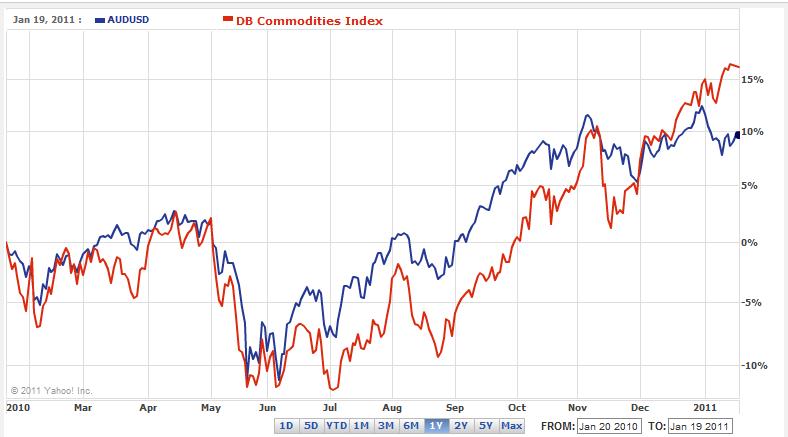
If you chart the recent performance of the Australian Dollar, you will notice that it almost perfectly tracks the movement of commodities prices. (In fact, if not for the fact that commodities are more volatile than currencies, the two charts might line up perfectly!) By no coincidence, the structure of Australia’s economy is increasingly tilted towards the extraction, processing, and export of raw materials. As prices for these commodities have risen (tripling over the last decade), so, too, has demand for Australian currency.
To take this line of reasoning one step further, China represents the primary market for Australian commodities. “China, according to the Reserve Bank of Australia, accounts for around two-thirds of world iron ore demand, about one-third of aluminium ore demand and more than 45 per cent of global demand for coal.” In other words, saying that the Australian Dollar closely mirrors commodities prices is really an indirect way of saying that the Australian Dollar is simply a function of Chinese economic growth.
Going forward, there are many analysts who are trying to forecast the Aussie based on interest rates and risk appetite and the impact of this fall’s catastrophic floods. (For the record, the former will gradually rise from the current level of 4.75%, and the latter will shave .5% or so from Australian GDP, while it’s unclear to what extent the EU sovereign debt crisis will curtail risk appetite…but this is all beside the point.) What we should be focusing on is commodity prices, and more importantly, the Chinese economy.
Chinese GDP probably grew 10% in 2010, exceeding both economists’ forecasts and the goals of Chinese policymakers. The concern, however, is that the Chinese economic steamer is now powering forward at an uncontrollable speed, leaving asset bubbles and inflation in its wake. The People’s Bank of China has begun to cautiously lift interest rates, raise reserve ratios, and tighten the supply of credit. This should gradually trickle down in the form of price stability and more sustainable growth.
Some analysts don’t expect the Chinese economic juggernaut to slow down: “While there is always a chance of a slowdown in China, the authorities there have proved remarkably adept at getting that economy going again should it falter.” But remember- the issue is not whether its economy will suddenly falter, but whether those same “authorities” will deliberately engineer a slowdown, in order to prevent consumer prices and asset prices from rising inexorably.
The impact on the Aussie would be devastating. “A recent study by Fitch concluded that if China’s growth falls to 5pc this year rather than the expected 10pc, global commodity prices would plunge by as much as 20pc.” [According to that same article, the number of hedge funds that is betting on a Chinese economic slowdown is increasing dramatically]. If the Aussie maintains its close correlation with commodity prices, then we can expect it to decline proportionately if/when China’s economy finally slows down.

Wednesday, June 29, 2011

Archive for the 'Australian Dollar' Category

Archive for the 'Australian Dollar' Category

Tide is Turning for the Aussie

“Australia is about to enter a boom that should last decades…The Australian dollar is unlikely to go back to where it was, and manufacturing will shrink in importance to the economy, perhaps even faster than it has been.” This, according to Martin Parkinson, Treasury Minister of Australia. While 30 years from now, Mr. Parkinson’s prognosis might probe to be accurate, I’m not so sure it applies to the period 3 months from now. Here’s why:
First of all, the putative economic boom that is taking place in Australia is being driven entirely by high commodity prices and surging production and exports. Since peaking at the end of April, commodity prices have fallen mightily. You can see from the chart above that there continues to exist a tight correlation between the AUD/USD and commodities prices. As commodities prices have fallen over the last two months, so has the Australian Dollar.


In addition, while demand will probably remain strong over the long-term, it may very well slacken over the short-term, due to declining economic growth across the industrialized world.  Consider also that Australia’s largest market for commodity exports – China – may have difficulty sustaining a GDP growth rate of 10%, and at the very least, new fixed-asset investment (which necessitates demand for raw materials) will temporarily peak in the immediate future.
Finally, the mining sector directly accounts for only 8% of Australia’s economy, which means that only to a limited extent to high commodities prices contribute to the bottom line of Australian GDP. This notion is reinforced by the 1.2% economic contraction in the second quarter – the biggest decline in 20 years – and the fact that GDP is basically flat over the last three quarters. Many non-mining economic indicators are sagging, and the number of corporate bankruptcies is 10% higher than in 2010. In the end, then, the ebb and flow of Australia’s fortune depends less on commodities, and more on other sectors.

Mr. Parkinson’s optimistic forecasts might also be undermined in the short-term by a looser-than-expected monetary policy. The Reserve Bank of Australia last hiked its benchmark interest rate in November 2010, and may not hike again for a few more months due to moderating economic growth and proportionally moderate inflation. Given that an attractive interest rate differential may be driving some of the speculative activity that has girded the Aussie’s rise, a decline in this differential could likewise propel it downward.
That’s because anecdotal reports suggest that the Australian Dollar remains a popular long currency for carry traders, funded by shorting the US Dollar, and to a lesser extent, Japanese Yen. Given that many of these carry trades are heavily leveraged, it wouldn’t take much to trigger a short squeeze and a rapid decline in the AUD/USD. For evidence of this phenomenon, one has to look no further back than May 2010, when the Aussie fell 10-15% in only three weeks.

Ultimately, as one commentator recently pointed out, the Aussie’s 70% rise since 2008 might better be seen as US Dollar weakness (which also catalyzed the rise in commodity prices). The apparent stabilizing of the dollar, then, might let some air out of the currency down under.