.

Friday, May 16, 2014

Chinese Yuan: Further Appreciation is Inevitable

Chinese Yuan: Further Appreciation is Inevitable
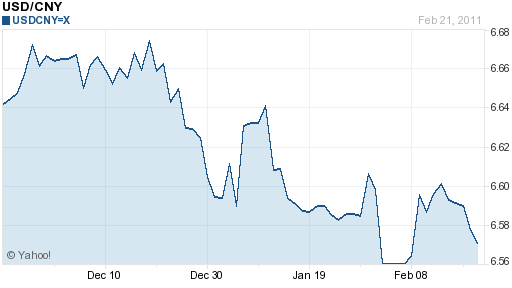
Relatively speaking, the Chinese Yuan has been on a tear, appreciating ~1% in a little more than a month. One has to wonder whether this is a concession by the People’s Bank of China (PBOC) that its exchange rate regime is not viable or whether its instead a political sop. The question on everyone’s minds, of course,
is, will it continue?

Countries around the world have continued to criticize China for its unwillingness to allow the Yuan to appreciate. At last week’s G20 meeting, US Treasury Secretary Timothy Geithner and Fed Chairman Ben Bernanke separately took aim. “They’re still heavily leaning against the forces trying to push their currency up,” complained Geithner. “The maintenance of undervalued currencies by some countries has contributed to a pattern of global spending that is unbalanced and unsustainable,” intimated Bernanke.
However, it was only when fellow emerging market economies – namely Brazil – voiced similar concerns, that China was finally forced to concede partial defeat. It signed on to an official G20 communique that declared that exchange rates and current account balances would be used to determine whether a particular country’s policies were contributing to global economic imbalances. Alas, the Communique (and the G20, for that matter) is deliberately vague and unenforceable; it’s more symbolic than anything else.
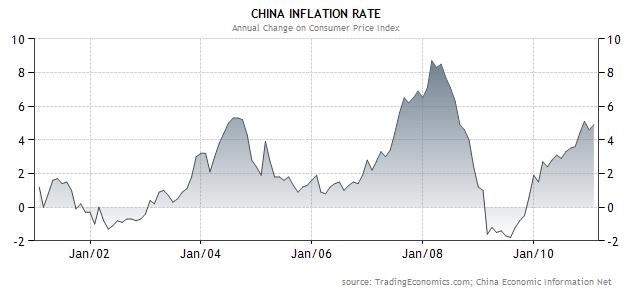
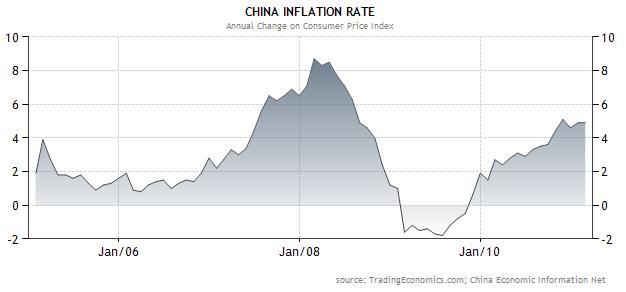
Still, China is not one to take its cues – especially on issues as important as the Yuan – from the international community. That the Yuan is now appreciating at a steady clip (~5% in annualized terms) is almost certainly being driven more by pragmatism than politics. Specifically, it represents the most effective tool to combat inflation, which has already breached 5% and continues to tick higher.

China critics forget that China’s fixed exchange rate regime is not a free lunch. While it almost certainly gives the export sector a competitive advantage, it also deprives the PBOC of the ability to conduct monetary policy and is inherently inflationary. That’s because the policy necessitates soaking up all of the foreign currency that enters the country (hence the ~$3 Trillion in forex reserves) and instead printing new Chinese Yuan and putting into circulation. When you combine a 15% annual increase in the money supply with soaring economic growth, a surge in bank lending, real estate boom, and rising commodity prices, the inevitable result is inflation. The country’s economic officials have responded by tightening credit and raising interest rates, but these will ultimately fail as long as the Fed’s QE2 program continues to send US Dollars into China.
In addition to allowing the Yuan to slowly appreciate, China has also moved to make the Yuan more convertible. This has the dual advantages of making China less reliant on the US Dollar and on relieving upward pressure on the Yuan. More of its trade is being settled directly in Chinese Yuan. Chinese companies are being encouraged to invest outside of China, and foreign companies inside of China are gradually being permitted to issue Yuan-denominated bonds, rather than import Dollars to fund new investments.
It appears that all of these measures are actually starting to have some impact. China’s trade surplus is shrinking. The IMF has suggested that the Chinese Yuan could one day be an international reserve currency and could be a component of its Special Drawing Rights (SDR) currency. Less hot money (distinct from investment inflows) is finding its way into China.
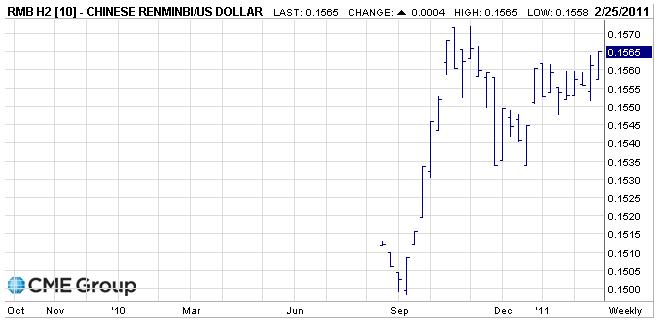
Unfortunately, most analysts are skeptical that it will last. Futures markets reflect a modest 2.5% appreciation against the Dollar over the next 12 months. I’m personally anticipating a rise of 4-5%, though I think it will ultimately be tweaked depending on inflation.

Thursday, June 2, 2011

Is the Chinese Yuan the Most Reliable Forex Trade?

Is the Chinese Yuan the Most Reliable Forex Trade?
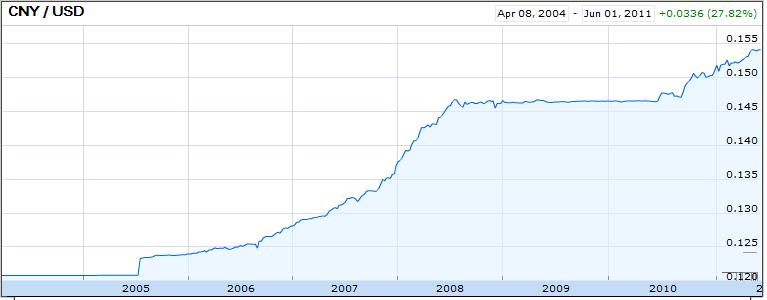
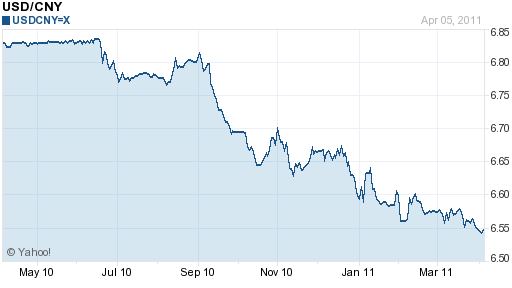
Over the last six years, the appreciation of the Chinese Yuan has been as reliable as a clock. Since 2005, when China tweaked the Yuan-Dollar peg, it has risen by 28%, which works out to 4.5% per year. If you subtract out the two year period from 2008-2010 during which the Yuan was frozen in place, the appreciation has been closer to 7% per year. There is no other currency that I know of whose performance has been so consistently solid, and best of all, risk-free!

As I wrote in an earlier post on the subject, the economic case for further appreciation is actually somewhat flimsy. When you factor in the 5-10% inflation that has eroded the value of the Yuan over the last few years, its appreciation in real terms has more than exceeded the 25-40% that economists and politicians asserted as the margin by which it was undervalued. While prices for many services remain well below western levels, prices for manufactured goods already equal or exceed those that Americans pay. (As a resident of China, I can assure you that this is the case!). Given that Chinese GDP per capita (a proxy for income) is 12 times less than in the US, that means that relative price levels in China are already significantly greater than the US. Thus, further appreciation would only cause further distortion.
Regardless, investors continue to brace for further appreciation, and expectations of 5-6% for the foreseeable future are the norm. Even futures contracts – which typically lag actual appreciation because of their non-deliverable nature – are pricing in higher expectations for appreciation. Perhaps the greatest indication is that 9% of all of the capital pouring into China is so-called “hot-money.” That means that despite the 27% appreciation to date, a substantial portion of investment in China is connected only to the expectation for further Yuan appreciation.
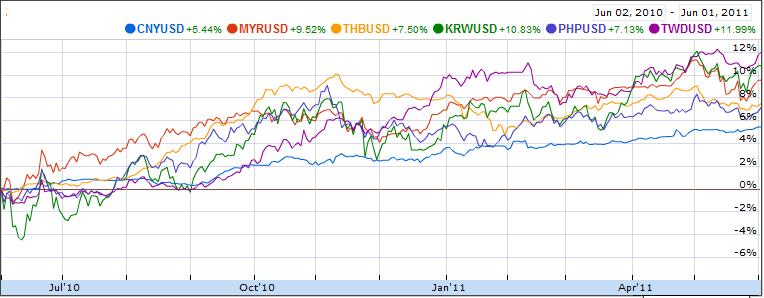
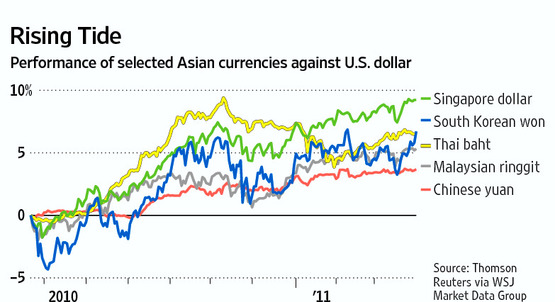
Even though the Yuan is not fully-tradeable, its continued rise has serious implications for forex markets. First of all, there will be follow-on effects for other currencies. Almost every emerging market economy competes directly with China, and all are thus keenly aware that China pegs its currency against the US dollar. By extension, many of these economies feel they have no choice but to intervene daily in forex markets to prevent their respective currencies from appreciating faster than the RMB.
At the very least, the appreciation in Asian and Latin American currencies will keep pace with the Yuan: “This is a long-term secular trend for emerging market currencies especially in Asia. Asian currencies have long been undervalued and they are on a convergence path with the United States and the G7 more broadly and that’s going to lead to an appreciation,” summarized one analyst.
All of this action will cause the dollar to depreciate. The Chinese Yuan alone accounts for 20% of the Federal Reserve Bank’s trade-weighted dollar index, and Asia ex-Japan accounts for another 20%. Regardless of the other G4 currencies perform, that means that a conservative 7% annual appreciation in Asia will drive a minimum 3% annual decline in the trade-weighted value of the dollar. Even worse is that this cause a broad loss of confidence in the dollar, driving the dollar lower across-the board. And this doesn’t even aaccount for the multiplier effect that net exporters will no longer need to indiscriminately accumulate dollar-denominated assets. China, itself, has unloaded part of its massive hoard of US Treasury securities for five consecutive months.
The implications for how long-term investors should position themselves are clear. Unfortunately, while further appreciation in the Chinese Yuan is all but guaranteed, achieving exposure to this appreciation is beyond difficult. Neither of the ETFs that claim to represent the Yuan (CNY, CYB) have budged over the last couple years, and they are a poor substitute for the actual thing. In other words, your only chance for exposure is indirectly via Chinese stocks and bonds, which are far from transparent and an extremely dubious investment. Or you could try opening a Chinese Yuan bank account with the Bank of China (which now has branches in the US), but it’s unclear whether you will be able to capture 100% of gains from the Yuan’s appreciation.
Otherwise, emerging market Asia seems like a pretty good proxy. Of course, you need to be aware that even though the Korean Won, Malaysian Ringgit, Thai Baht, New Taiwan Dollar, Indonesian Rupiah, Philippine Peso, etc. will probably at least match the rise in the Yuan, they are imperfect substitutes for the Yuan, since they are driven more by country-specific factors than by association to China.

Tuesday, May 3, 2011

The Diminished Case for Chinese Yuan Appreciation

The Diminished Case for Chinese Yuan Appreciation
The Chinese yuan has appreciated by more than 27.5% since 2005, when the People’s Bank of China (“PBOC”) formally acceded to international pressure and began to relax the yuan-dollar peg. For China-watchers and economists, that the Yuan will continue to appreciate is thus a given. There is no question of if, but rather of when and to what extent. But what if the prevailing wisdom is wrong? What if the yuan is now fairly valued, and economic fundamentals no longer necessitate a further rise?


Prior to the 2005 revaluation, economists had argued that the yuan (also known as the Chinese RMB) was undervalued by 15% – 40%, and American politicians had used this as a basis for proposing a 27.5% across-the-board tariff on all Chinese imports. Given that the yuan has now appreciated by this exact margin (and by even more when inflation is taken into account), shouldn’t this alone be enough to silence the critics, without even having to look at the picture on the ground? How can Senator Charles Schumer continue to press for further appreciation when the yuan’s rise exceeds his initial demands? Alas, election season is upon us, and we can’t hope to make political sense out of this issue. We can, however, attempt to analyze the economic sense of it.
China manipulates the value of the yuan in order to give a competitive advantage to Chinese exporters, goes the conventional line of thinking. Look no further than the Chinese trade surplus for evidence of this, right? As it turns out, China’s trade surplus is shrinking rapidly. In 2006, it was a whopping 11% of GDP. Last year, it had fallen to 5%, and it is projected by the World Bank to settle below 3% for each of the next two years. Thanks to a first quarter trade deficit – the first in over seven years – China’s trade surplus may account for a negligible portion (~.2%) of GDP growth in 2010.

With this in mind, why would the PBOC even think about allowing the RMB to appreciate further? According to one perspective, the narrowing trade imbalance is only temporary. When commodities prices settle and global demand fully recovers, a wider trade surplus will follow. In fact, the IMF forecasts China’s current surplus will rise to 8% by 2016. As you can see from the chart below (courtesy of The Economist), however, the IMF’s forecasts have proven to be too pessimistic for at least the last three years, and it now has very little credibility. Besides, China’s economy is gradually reorienting itself away from exports and towards domestic spending. As a resident of China, I can certainly attest to this phenomenon, and the last few years has seen an explosion in the number of cars on the road, domestic tourism, and conspicuous consumption.

A better argument for further RMB appreciation comes in the form of inflation. At 5.4%, inflation is officially nearing a 3-year high, and there is evidence that the PBOC already recognizes that allowing the RMB to keep rising represents its best tool for containing this problem. It has already raised banks’ required reserve ratio several times, but there is a limit to what this can accomplish. Meanwhile, the PBOC remains reluctant to raise interest rates because it will invite further “hot-money” inflows (estimated at more than $100 Billion per year, if not much higher) and potentially destabilize the banking sector. By raising the value of the yuan, the PBOC can blunt the impact of rising commodities prices and other inflationary forces.
In fact, some think that the PBOC will quicken the pace of appreciation, a view that as supported by last month’s .9% rise. Others think that a once-off appreciation would be more effective, and is hence more likely. This would not only remove the motivation for further hot-money inflows, but would also reduce the PBOC’s need to continue accumulating foreign exchange reserves. At $3 trillion+ ($1.15 trillion of which are held in US Treasury Securities), these reserves are already a massive headache for policymakers. Merely stating the obvious, PBOC Governor Zhou Xiaochuan has officially called the reserves “really too much.” (It’s worth pointing out that the promotion of the yuan as an international currency is backfiring in some ways, causing the reserves to balloon even faster).
For the record, I think that the Chinese yuan is pretty close to being fairly valued. That might seem like a ridiculous claim to make when Chinese wages and prices are still well below the global average. Consider, however, that the same is true for the majority of emerging market economies, including those that don’t peg their currencies to the dollar. That doesn’t mean that the yuan won’t – or that it shouldn’t – continue to rise. In fact, the PBOC needs to do more to ensure that the Yuan appreciates evenly against all currencies, since most of the yuan’s rise to-date has taken place relative to the US Dollar. It’s merely a commentary that the PBOC is close to fulfilling the promises it has made regarding the yuan, and going forward, I think that observers should expect that its forex policy will be reconfigured to promote domestic macroeconomic policy objectives.
Saturday, April 9, 2011

Report Portends Changes to Forex Reserve Currencies

Report Portends Changes to Forex Reserve Currencies
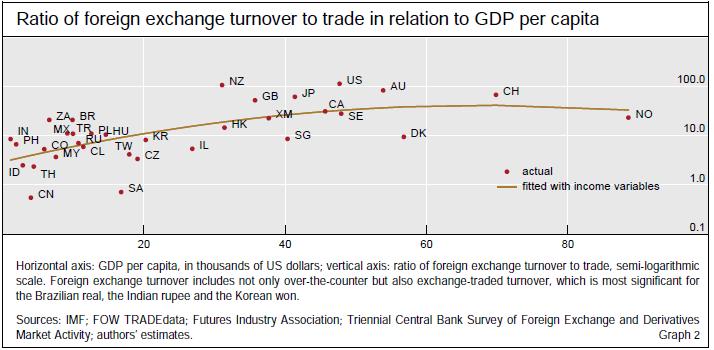
This week’s Bank of International Settlements (BIS) quarterly report came with some interesting revelations (most of which I’ll discuss in a later post). Below, I’d like to focus on one particularly interesting section entitled, “Foreign exchange trading in emerging currencies.” This section carries tremendous implications for the future of reserve currencies and is a must read for fundamental analysts.

According to the BIS, “Foreign exchange turnover evolves in a predictable fashion with increasing income. As income per capita rises, currency trading cuts loose from underlying current account transactions…moreover, currencies with either high or very low yields attract more trading, consistent with their role as target and funding currencies in carry trades.” In other words, the most liquid currencies (and hence, most suitable reserve currencies) are primarily those of advanced economies and secondarily those with abnormal interest rates.
In theory, one would expect a close correlation between forex turnover and trade. In fact, this turns out to be precisely the case for lesser-developed countries. Since the capital markets of such countries are commensurately undeveloped, offering limited opportunities for foreign investment, most of the demand for their currencies stems directly from trade. In fact, the currencies of Malaysia, Indonesia, Saudi Arabia, and (notably) China closely fit this profile, with a 1:1 ratio between forex turnover and trade.
At the same time, the BIS discovered a strong correlation between the ratio of foreign exchange turnover to trade and GDP per capita.  That means that as a country grows economically and enters the realm of industrialized countries, its currency will experience exponential growth in turnover. For example, the British Pound and Japanese Yen are exchanged at a quantity that is 50 times greater than required for trading purposes. The ratio of forex turnover to trade for the US Dollar, meanwhile, exceeds 100!
The BIS was able to fit a regression line to the data that seemed to explain this phenomenon quite well. The majority of economies/currencies that it surveyed fall pretty close to this line, suggesting that forex turnover is exactly where it should be relative to GDP per capita and trade. In fact, the line runs directly through the Euro, Hong Kong Dollar, Canadian Dollar, and Swedish Krona, and Norwegian Krona.
There are also plenty of outliers. Given the size of China’s economy, for instance, the model would predict that turnover in the Chinese  Yuan should be 2-3 times what it currently is. Unsurprisingly, all of the world’s major reserve currencies (except for the Euro) can be found well on the other side of the regression line. Turnover in the US Dollar, Japanese Yen, and Australian Dollar is almost twice as high as the model predicts. Perhaps the most flagrant outlier is the New Zealand Dollar, which seems to be traded at a frequency that is 8-10x higher than it should be. Of course, New Zealand is a unique case; there isn’t another economy that is as small and stable, and yet always has higher-than-average interest rates.
One interpretation of this analysis is that demand for the all of the currencies that fall above the regression line should decline over time, and should experience at least some depreciation. The opposite can be said for currencies that currently fall the regression line, especially if their economies continue to expand at a faster-than average pace.
At the same time, it puts things into perspective. Even if demand for the Chinese Yuan doubled in accordance with the BIS model (which would necessitate looser capital controls, among other things), GDP per capital would need to increase 20x and US GDP per capita would need to remain constant in order for the Yuan to rival the Dollar in importance. Also, I’m beginning to wonder if the New Zealand Dollar isn’t in fact oversubscribed and overvalued…

Wednesday, April 6, 2011

G20 Pressures China, Despite Yuan Appreciation

G20 Pressures China, Despite Yuan Appreciation
Since the People’s Bank of China (PBOC) unfixed the Chinese Yuan in June, it has appreciated 4.5%. Moreover, for a handful of reasons, it looks like China will continue allowing the RMB to appreciate at the same steady pace for the foreseeable future. And yet, the international community continue to use China as a scapegoat for all global economic ills, and are pressuring it to stop trying to control the Yuan altogether.


At the recent G20 conference in China, US Treasury Secretary Tim Geithner circumvented China’s request to avoid discussing its currency policy: “Flexible exchange rates help countries better absorb shocks and that the tension between flexible currencies and those that are ‘tightly managed’ is ‘the most important problem to solve in the international monetary system today.’ ” Naturally, Chinese officials countered that the Dollar is to blame for the recent financial crisis and the ongoing economic imbalances.
If China was the only country to attempt to control its currency, perhaps the rest of the world would be willing to overlook it and write it off to ideological differences like they do with many of its protectionist economic policies. In this case, however, China’s tight control of the Yuan has spurred many of the countries with which it competes to similarly intervene in forex markets. In the last week alone, South Korea, Malaysia, Singapore, and Thailand are all suspected of buying Dollars to hold down their respective currencies. Meanwhile, Brazil is enhancing its capital controls and Japan stands ready to intervene should the Yen spike again.

To quote Secretary Geithner again, “This asymmetry [between nations that intervene and those that don't] in exchange rate policies creates a lot of tension. It magnifies upward pressure on those emerging-market exchange rates that are allowed to move and where capital accounts are much more open. It intensifies inflation risk in those emerging economies with undervalued exchange rates. And, finally, it generates protectionist pressures.” In short, when one country decides not to play the rules, other countries are quick to catch on. [To be fair, while the US doesn't intervene directly on behalf of the Dollar, it still deserves some blame for this tension because of QE2 and the like].
If any country appears to be taking these lessons to heart, however, it is China. To combat inflation, it has raised interest rates several times over the last twelve months, including yesterday’s surprise 25 basis point hike. Given that official inflation remains above 5% (and living here, I can tell you that the actual rate is probably 10-20%), the PBOC has no choice but to continue tightening monetary policy if it wishes to avoid social unrest. To counter the inevitable upward pressure on the Yuan, it has taken such measures as prodding Chinese firms to look abroad for acquisition targets. China’s forex policy is designed to serve one very important end: to buttress the competitiveness of its export sector. However, there are early indications that China’s preeminent position as the world’s sweatshop may be about to slide. Anecdotal reports show that manufacturers are unnerved by wage and raw materials inflation, and are uprooting factories. In the short-term, some of this production will move inland from the coast, but even this has its limits. According to Credit Suisse, “Salaries for China’s estimated 150 million migrant workers will rise 20 to 30 percent a year for the next three to five years…’It may take a decade for China to see its export competitiveness erode, but we have seen the beginning of this happening.’ ”
With this in mind, it’s clearly futile for China to continue to focus its economic policy around low-cost, labor-intensive exports. Likewise, it’s ridiculous to continue to artificially depress the Yuan, especially if it’s serious about turning it into a global reserve currency. I think Chinese policymakers recognize this, and I stand by my earlier prediction that the Yuan will maintain a steady pace of appreciation for the foreseeable future.

Tuesday, March 22, 2011

“Currency Manipulation” Will Continue, Despite G20

Last month, the G20 finally agreed on the specific factors that would be used to determine whether a country was manipulating its currency. Despite being watered-down (by the usual suspects), the so-called “scorecard” is nonetheless extremely substantive. Unfortunately, the resolution will be backed only by “peer pressure,” rather than any kind of real enforcement mechanism, which means that in practice it is basically worthless.
 
While the proximate goal of the resolution is to eliminate exchange rate manipulation, it’s ultimate goal is to minimize the risk of another economic/financial crisis. Towards that end, a country’s “budget deficit levels, the external imbalance and private savings rates” will be closely scrutinized, and will be warned if any of these factors reach levels that are deemed to be unsustainable. The idea is that an early warning system will prevent the global economy from reaching a point of disequilibrium that is so severe that crisis would be impossible to avert.
 
Of course, the problems with this program are manifold. First of all, there are no concrete numbers. For example, it’s not clear how large a country’s national debt or trade deficit has to reach before it receives a phone call and slap on the wrist from the G20. In fact, you could argue that the same imbalances that precipitated the crisis are largely still in place, which means that some countries should have been warned yesterday.
 
Second, there is no meaningful enforcement mechanism. That means that countries that disregard the resolution don’t really have anything to fear, other than the wrath of investors. In other words, if governments and Central Banks know that they can manipulate their exchange rates with impunity, what’s to stop them? Look at Japan: its public debt is the highest in the world. It runs a perennial trade surplus. Its citizens are notorious savers. And yet, when the Yen rose to a record high, which you might expect from such an imbalanced economy, the G7 (in this case) took the unusual step of pushing the Yen down. I’m not saying this wasn’t the right thing to do, but what kind of signal does this send to other rule breakers.
 
While all emerging market countries took an active interest in exchange rates (and seek to exert some control over their currencies), China is certainly Public Enemy #1, and is the clear target of the “currency manipulation” talk. To its credit, the People’s Bank of China (PBOC) has permitted the Chinese Yuan to appreciate 20% against the Dollar (probably 30% when inflation is taken into account) over the last few years. Meanwhile, both internal government statisticians and the IMF expect its current account surplus to narrow to a mere 5% in 2011, as its economy slowly rebalances.
 
In this sense, I think China is a case in point that the best enforcement mechanism is reality. Specifically, China has reached a point where it cannot continue to pursue an economic policy based on exports, without spurring inflation and causing the inefficient allocation of domestic capital (such as in real estate). It must raise interest rates and accept the continued appreciation of the RMB is an unavoidable byproduct.
 
The same goes for other countries that attempt to hold their currencies down. If they can get away with it, then so be it. If not, I can guarantee that it won’t be the G20 that forces them to change.